Construction Technology
Construction Technology
The Construction Technology program is approved by the National Center for Construction, Education, and Research (NCCER). At program completion students will receive NCCER certification.
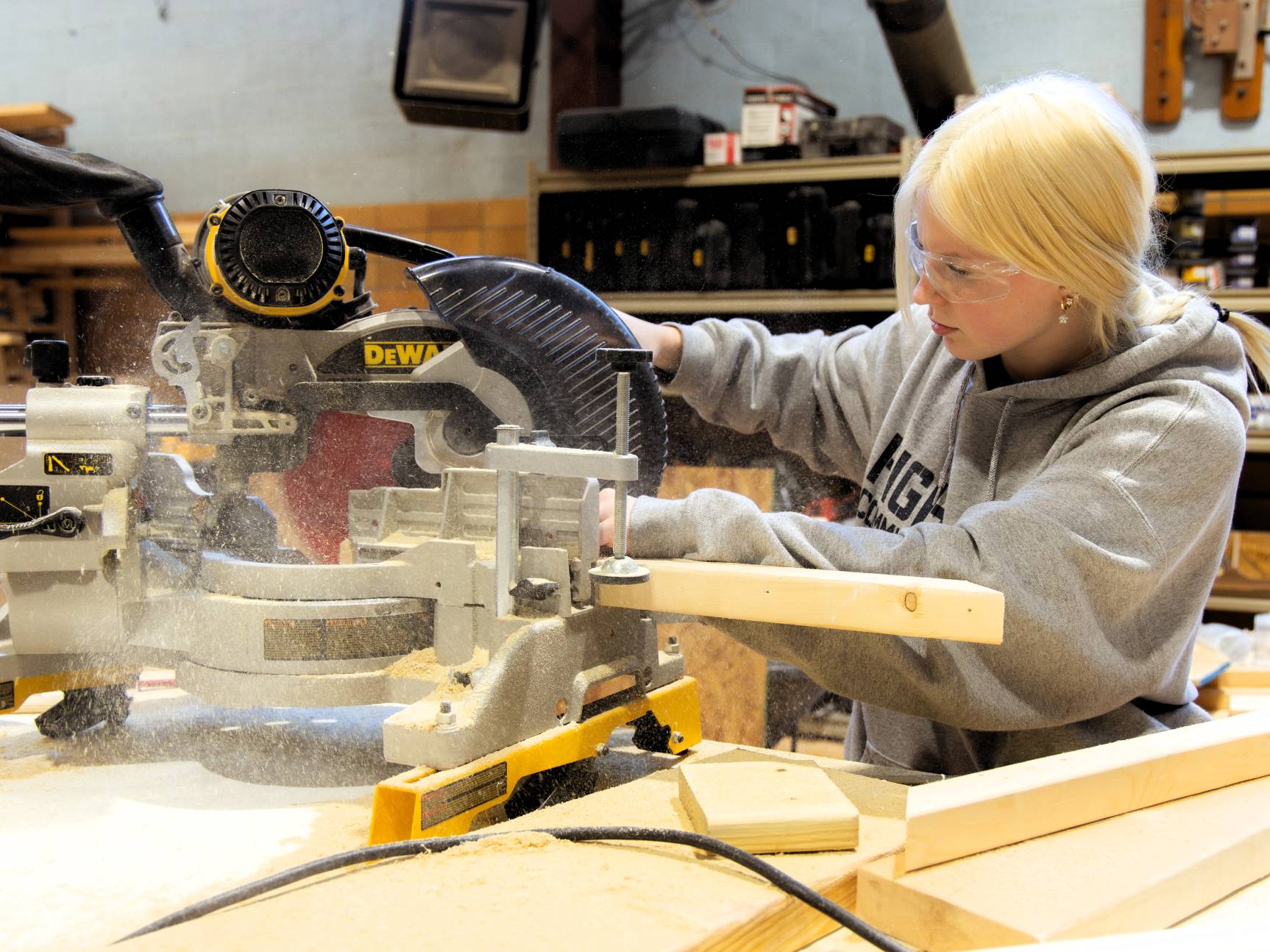
Students in this program gain practical, hands-on experience through a variety of construction projects. Instruction covers all phases of construction, allowing students to build skills from foundational concepts through finishing techniques. Full-time students can enter the workforce at the completion of this nine-month program.
The Construction Technology program aligns with the National Center for Educational Statistics. CIP Code 46.0201: Carpentry/Carpenter. A program that prepares individuals to apply technical knowledge and skills to lay out, cut, fabricate, erect, install, and repair wooden structures and fixtures, using hand and power tools. Includes instruction in technical mathematics, framing, construction materials and selection, job estimating, blueprint reading, foundations and roughing-in, finish carpentry techniques, and applicable codes and standards.
Certifications: Students in the Construction Technology program complete OSHA10 training and may earn certifications from the National Center for Construction Education & Research (NCCER) General Carpentry I and II
Helpful Resources
- Certificate B Degree Map
- 2022 Wage Survey
- Approved for Kansas Promise Scholarship
Campus Locations
- Technical Center
- 1501 West Riley Atchison, KS 66002
- hcctc@highlandcc.edu
- (785) 442-6180
- Western Center
- 313 Nemaha Baileyville, KS 66404
- western@highlandcc.edu
- (785) 442-6240
View Construction Courses
Construction Technology Courses
31 Total Credit Hours
*This course is recognized by the Kansas Board of Regents as Common or Support course within the program.
1 Credit Hours
This course covers the tools and materials required for the Building Trades. Students will be introduced to wood and lumber, engineered panels, and engineered lumber products, fasteners, hand tools, portable power tools, and stationary power tools. Students will begin to safely operate hand and power tools. This course covers the safety and job hazards for the building trades industry. Students will identify types of job hazards, accident prevention measures, lists classes of fires, be familiar with a fire extinguisher, demonstrate proper methods of lifting, list forms of eye protection, learn ways to protect hands when working with a table saw.
3 Credit Hours
This course includes the general and specific introduction into the construction business. The study of the Occupational Outlook and the various types of jobs available is also included. Students will need to pass a safety test on hand and power tools and equipment operations. The course also presents basic mathematics and its application to the construction industry.
4 Credit Hours
This is a step by step class that teaches the student how to use equipment, tools and fasteners; measure, cut, drill, join, fasten and finish various types of hardwoods and softwoods. The student will read, and interpret plans, elevations, schedules, sections, and details contained in basic construction drawings. Students master a variety of construction skills by applying knowledge through their participation in a ‘student design-built’ house project.
4 Credit Hours
The Carpentry I course helps learners to build general carpentry skills through NCCER General Carpentry curriculum. The included NCCER General Carpentry modules prepare individuals for entry-level positions on project sites by providing instruction and hands-on training for an orientation to the carpentry trade, building materials and fasteners, construction plans & documents, and site and building layout. Students taking this course, combined with the Carpentry II course, will be prepared to take and pass the General Carpentry exam to earn the NCCER General Carpentry credential. All content from NCCER General Carpentry 6th edition modules
5 Credit Hours
The Carpentry II course helps learners to build general carpentry skills through NCCER General Carpentry curriculum. The included NCCER General Carpentry modules prepare individuals for positions on project sites by providing instruction and hands-on training on the components and construction systems for floors, walls, roof framing, stairs, and building envelope. Students taking this course, combined with the Carpentry I course, will be prepared to take and pass the General Carpentry exam to earn the NCCER General Carpentry credential. All content from NCCER General Carpentry 6th edition modules.
3 Credit Hours
Though the finishing of footings, foundations, and floor slabs is typically done by subcontractors, there are occasions when the residential carpenter is called on to build basic forms and place reinforcing materials in the structure. This course is a study of the reinforcing materials, concrete and basic formwork used in construction. Student will learn how to perform several masonry and concrete finishing tasks, such as mixing concrete, building footings, edges and wall forms and using concrete reinforcing materials.
3 Credit Hours
The attractiveness of a home is often determined by the quality of its finish. Care needs to be taken in selecting the materials to finish the interior of the home. This course describes the various materials used for insulating the home, finishing the walls and ceilings, and cabinetry.
4 Credit Hours
Exterior Carpentry focuses on various types of exterior finish materials, thermal and moisture protection, Roofing applications and their installation procedures. Materials include wood, metal, vinal, and fiber-cement siding. Installation of various types of insulation materials in walls, floors, and attics and proper installation practices for vapor barriers and waterproofing materials. Also, how to properly prepare the roof deck and install roofing for residential and commercial buildings
3 Credit Hours
This course is a study of the doors and door hardware and window, door, floor, and ceiling trim, and finish flooring. It includes installation, finish, and maintenance. The design style and installation of various types of trim. Experience in installing doors, trim, and flooring is included.
2 Credit Hours
Prerequisites: Course Prefix and Number
While there are many similarities between residential and commercial carpentry, there are often important differences including plans, materials and procedures required to meet the needs and standards of commercial projects. In this class we will study the different types of commercial drawings, the tools and procedures used in steel framing, and study how to estimate and install suspended ceiling systems.
1 Credit Hours
This course includes a study of the basic principles and practices of the electrical, HVAC and plumbing trades. It will serve as an introduction the various materials, tools and techniques used in these trades