Engineering Graphics & Technologies
Engineering graphics & technologies
If you enjoy problem-solving, creativity, and working on the computer, the Engineering
Graphics & Technologies (EGT) program may be the perfect fit for you. This 18-month
technical program at Highland Community College is designed for students who want
hands-on experience turning ideas into real-world solutions using industry-relevant
technology and software.
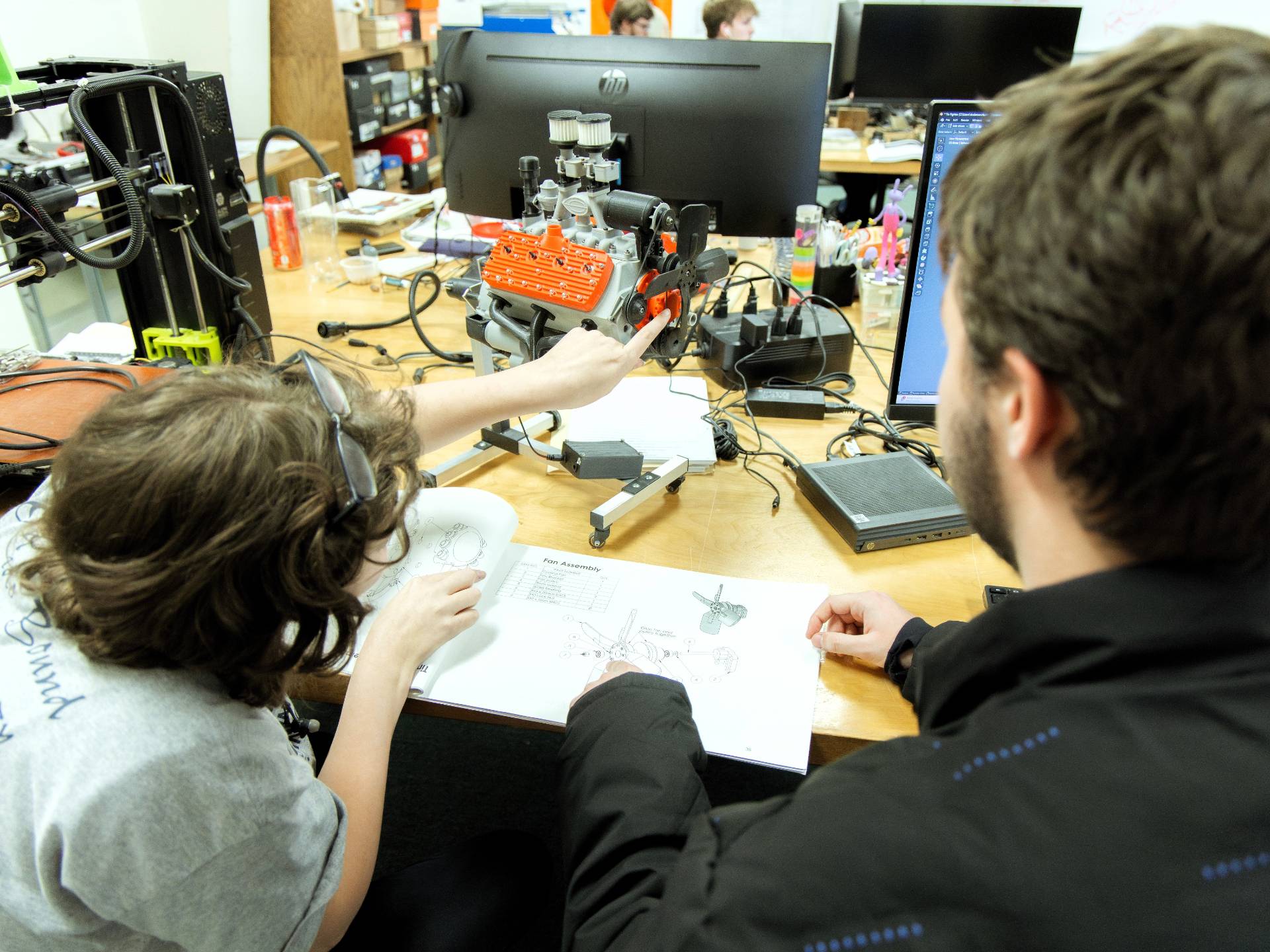
Students in the EGT program learn the fundamentals of engineering graphics, technical
design, and modeling while developing the skills needed to create accurate working
drawings and models. Through practical, project-based learning, students gain experience
that mirrors real industry expectations and prepares them for success in today’s workforce.
Upon completion of the program, graduates are prepared to enter the job market with
the skills needed to support engineering, manufacturing, construction, and design
teams. We invite you to visit the Highland Community College Technical Center, meet
the instructor, and explore how the Engineering Graphics & Technologies program can
help turn your interest into a career.
Helpful Resources
- Associate of Allied Science (AAS) | Degree Map; Degree Worksheet
- Certificate C | Degree Map
- 2022 Wage Survey
- Approved for Kansas Promise Scholarship
Available At These Locations
Engineering Graphics & Technologies Courses (56 Credits Total):
*This course is recognized by the Kansas Board of Regents as Common or Support course within the program.
4 Credit Hours
This course teaches the basic concepts of drafting communication. Subjects include line types, orthographic projections, sectioning, language, auxiliary views, pictorial drawings, and scale.
3 Credit Hours
This course teaches the basic concepts of print reading for machine trades. The student shall be able to interpret blueprints, and shop drawings, including interpreting geometric dimensioning and tolerancing symbols. Completion of this course the student shall be able to solve a construction problem utilizing shop drawings or blueprints.
1 Credit Hour
This course will explain job/site safety and precautions for job/site hazards; determine the uses of personal protective equipment (PPE); identify the safety equipment and procedures related to safe work practices and environment; identify fire prevention and protection techniques; explore Hazardous Communications (HazCom) including Material Safety Data Sheets (MSDA).
2 Credit Hours
The course provides for the study of basic measuring tools used in manufacturing industries. The course will allow students to gain proficiency in the use of basic manufacturing devices and an entry-level analysis of the results of these measurement techniques.
5 Credit Hours
This course provides the student with a basic understanding of computer drafting hardware and software, basic use and application of each. In-depth exploration of drawing, editing and coordinate input are developed.
4 Credit Hours
Prerequisite: CAD101
This course teaches the advanced concepts of drafting communication. Subjects include threaded fasteners, manufacturing materials, forming processes, dimensioning complex shapes, and assembly drawings.
3 Credit Hours
This introductory course the concepts and capabilities of Computer Numeric Control machine tools. Topics to include setup, operation, and basic applications. Upon completion students should be able to explain operator safety, machine operation, data input, program preparation, and program storage.
2 Credit Hours
This course teaches the basic concepts of Computer Aided Drafting communication and various applications. Subjects include templates, line types, orthographic projections, sectioning, language, auxiliary views, 2 and 3 dimensional objects, scale, plotting, assembly files, and Design Intent.
5 Credit Hours
Prerequisite: CAD131 This course provides the student with an advanced understanding of computer drafting hardware/software and the use and application of each. The course provides an in-depth development of drawing, editing, and coordinate set-up.
4 Credit Hours
Prerequisite: CAD151 This course teaches introductory concepts of drafting communication as it pertains to mechanical engineering and processes of manufacturing. Subjects include line types, orthographic projections, sectioning, language, auxiliary views, pictorial drawings, and scale usage.
4 Credit Hours
This course instructs the concepts and capabilities of Computer Numeric Control machine tools. Topics to include Computer Aided Drafting and Computer Aided Machining (CAD/CAM) integration, tooling processes, machine setup, machine controller operation, and the basic applications. Upon completion students should be able to integrate Computer Aided Drafting to Computer Aided Machining in both 2D and 3D milling and lathe, generate geometry and setup Computer Numeric Control processes using Mastercam software, apply tooling setup and operation, understand the Post Processor, and operate a Computer Numeric Control machine.
3 Credit Hours
This introductory course teaches basic machine shop operations. The student shall be able to understand and apply basic machining processes tolerancing symbols. Completion of this course the student shall be able to apply basic machining operations including, safety, calculations, metrology, blueprint reading, machining tooling, material science and other machine shop operations.
2 Credit Hours
The course provides for the study of measuring tools used in manufacturing industries. The course will allow students to gain proficiency in the use of manufacturing devices.
2 Credit Hours
Prerequisite: CAD182
This course covers basic parametric modeling. Working with CAD software students will work in three dimensions through shape description, sketching, and multi-view projection exercises. Students will work with mechanical drawings and specifications to assemble three-dimensional digital prototypes.
4 Credit Hours
Prerequisite: CAD201
This course teaches advanced concepts of drafting communication as it pertains to mechanical engineering and processes of manufacturing. Subjects include line types, orthographic projections, sectioning, language, auxiliary views, pictorial drawings, and scale usage.
3 Credit Hours
This course is designed to give students knowledge and practice which will enable them to feel comfortable with the computer. Emphasis will be placed on problem solving with the use of word processing, spreadsheet, database management and presentation software.
5 Credit Hours
Prerequisite: CAD232
This course covers advanced parametric modeling. Working with CAD software students will work in three dimensions through shape description, sketching, and multi-view projection exercises. Students will work with mechanical drawings and specifications to assemble three-dimensional digital prototypes.