Diesel Technology
Diesel Technology
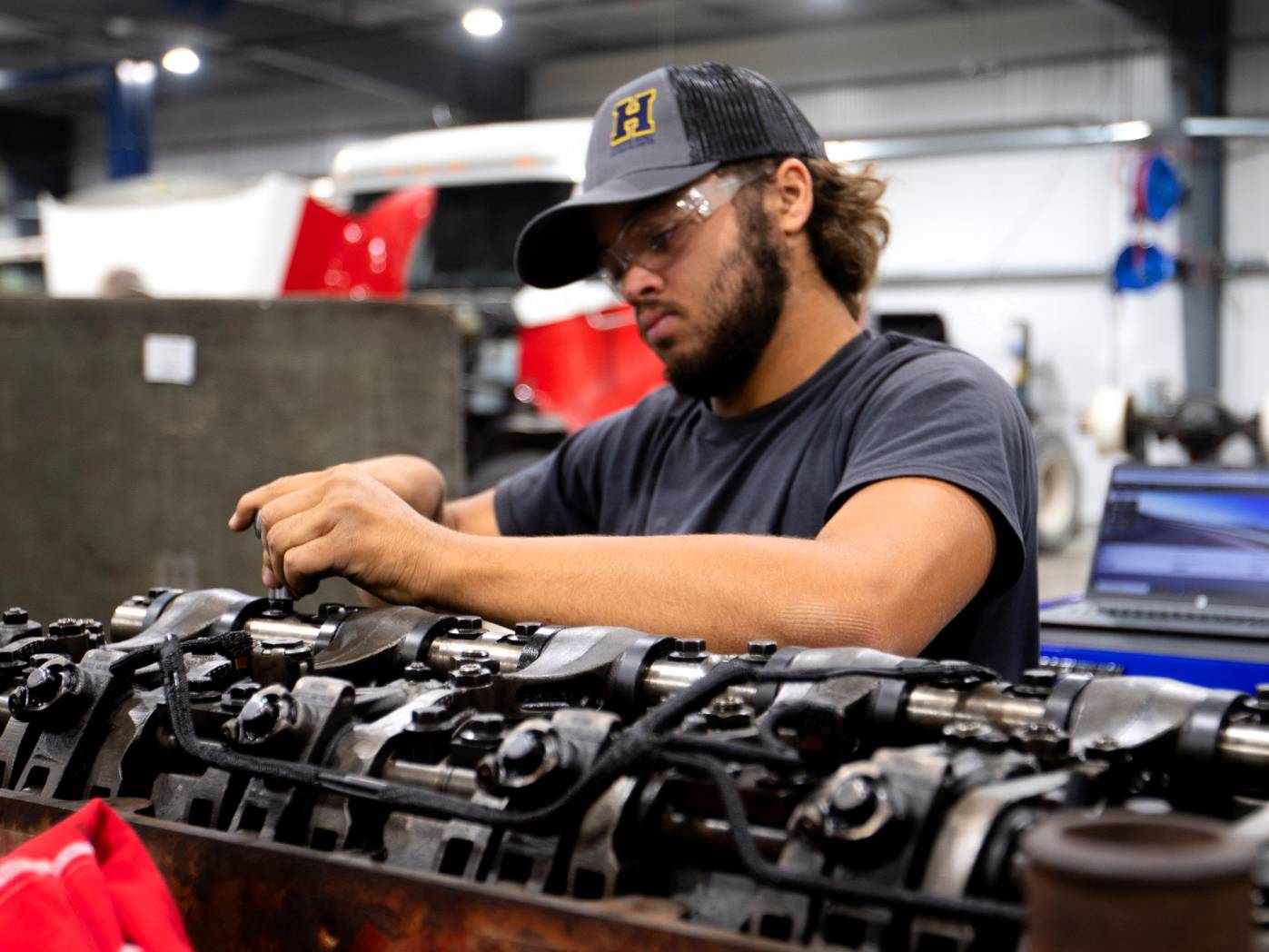
Responsibilities of trained diesel technicians are becoming more complex as more electronic components control engines. Students are trained to maintain, diagnose, and repair diesel engines. Much of the instruction is hands-on working in a "live" diesel shop.
The National Institute for Automotive Service Excellence (ASE) offers entry-level Medium/Heavy Truck cerifications. Toward the end of the program students will take the ASE Entry-Level Certification tests. ASE Entry-Level Certification can be thought of as the first step in building a career as a service professional
The Diesel Technology program aligns with the National Center for Educational Statistics (NCES). CIP Code 47.0613: Medium/Heavy Vehicle and Truck Technology/Technician. A program that prepares individuals to apply technical knowledge and skills to the specialized maintenance and repair of trucks, buses, and other commercial and industrial vehicles. Includes instruction in diesel engine mechanics, suspension and steering, brake systems, electrical and electronic systems, preventive maintenance inspections, drive trains, gasoline engine mechanics, HVAC systems, and auxiliary equipment installation and repair.
Certifications: Students in the Diesel Technology program complete OSHA10 training and are eligible to take the National Institute for Automotive Service Excellence (ASE) Entry-Level Medium/Heavy Truck certification tests in the areas of Brakes, Diesel Engines, Electrical/Electronic Systems, and Suspension & Steering.
Helpful Resources
- Associate of Applied Science | Degree Map; Degree Worksheet
- Certificate C | Degree Map
- 2022 Wage Survey
- Approved for Kansas Promise Scholarship
Available at These Locations
Diesel Technology Courses (53 Credits Total):
*This course is recognized by the Kansas Board of Regents as Common or Support course within the program.
1 Credit Hour
This course will: explain job/site safety and precautions for job/site hazards; determine the uses of personal protective equipment (PPE); identify the safety equipment and procedures related to safe work practices and environment; identify fire prevention and protection techniques; explore Hazardous Communications (HazCom) including Material Safety Data Sheets (MSDA).
4 Credit Hours
This course teaches the history of the diesel engine from the time of its invention to the present date and difference and advantages over other types of engines.
5 Credit Hours
This course teaches the three major engine companies products. Training engines are provided for all classes to ensure the student’s knowledge of troubleshooting maintenance, disassembly, overhaul, and reassembly techniques. Training is further enhanced by class discussion and visual media.
1 Credit Hours
This course includes basic principles and fundamentals of arc welding and acetylene cutting as applied to heavy equipment and diesel repairs. It also covers basic welding and acetylene safety.
3 Credit Hours
This course teaches disassembly, inspection, and troubleshooting of the three major types of clutch systems used by present engine manufacturers. The course also teaches installation techniques and adjustments.
4 Credit Hours
This course teaches the operating of fuel systems used on most modern diesel engines, how they differ from one another an service and adjustment of each system.
5 Credit Hours
This course of basic electrical systems on the diesel engine teaches troubleshooting and component testing using volt ohm meter and volt 33 testers.
3 Credit Hours
This course gives a student a short introduction to hydraulic systems. It covers major component identifications, their functions and how each component operates in the system.
2 Credit Hours
This course covers standard Db, DB2, and DM pump disassemble inspection and overhaul. It teaches removal, installation, and timing procedures on the above injection pumps. This course also teaches test stand operation, pump installation on the test stand, and proper calibration of the injection pump.
3 Credit Hours
This is an advanced training course in engine overhaul. Advanced training is provided to ensure the student’s knowledge of troubleshooting maintenance, disassembly, overhaul, and reassembly techniques.
5 Credit Hours
Students will become proficient in the diagnosis and repair of electrical circuits including testing, repairing, and/or replacing of components.
3 Credit Hours
This course teaches the theory of both open and closed center hydraulic systems. It covers pump overhaul and testing procedures. It also covers the use of hydraulic flow meter and testing procedures.
2 Credit Hours
This course covers refrigeration theory, operation, testing, and repair of air conditioning systems. The use of refrigerant recovery methods will also be discussed.
3 Credit Hours
This course teaches troubleshooting disassembly, inspection, and adjustments of both hydraulic and air brake systems with the advantages and disadvantages of both systems. The course also covers the two air systems, their components, and function in the brake system.
3 Credit Hours
This course introduces the concepts and principles of effective business management as they apply to diesel technology and includes forms of business ownership, typical business organizational structures, relationship of business to the community and the effect of government regulations on businesses.
3 Credit Hours
After completion of this course the student should be able to identify types of mechanical and auto transmissions they should be able to dissemble and reassemble transmissions correctly and be able to identify parts and why they have failed.
3 Credit Hours
This course covers standard DB, DB2, DM pump disassembly and overhaul. It teaches removal, installation, and timing procedures on the above injection pumps. This course also teaches test stand operation, pump installation on the test stand, and proper calibration of the injection pump.